
Crypto Market Continues Its Decline as Bitcoin Falls Below $86,000
The cryptocurrency sector extended its month-long downturn during Friday’s Asian trading hours, with the broader market struggling to regain momentum after a strong start earlier this year.
Bitcoin, the market’s key benchmark, slipped as much as 2.1%, dropping beneath $86,000 for the first time since April. The decline reflects fading buyer interest and a prolonged unwind from fast-moving traders following October’s record-setting surge. This pullback has left the market increasingly exposed to intensified selling and abrupt volatility. As of 10:59 a.m. in Singapore, Bitcoin was trading at $85,474.
According to James Butterfill, head of research at CoinShares, the downturn is being driven by major investors.
“Large whale accounts that follow the four-year cycle narrative are offloading heavy positions, and this stage of the cycle often coincides with falling prices,” he noted. “Even though we don’t view this cycle-based approach as fundamentally sound, it has taken on a self-fulfilling pattern, with more than $20 billion sold by big holders since September.”
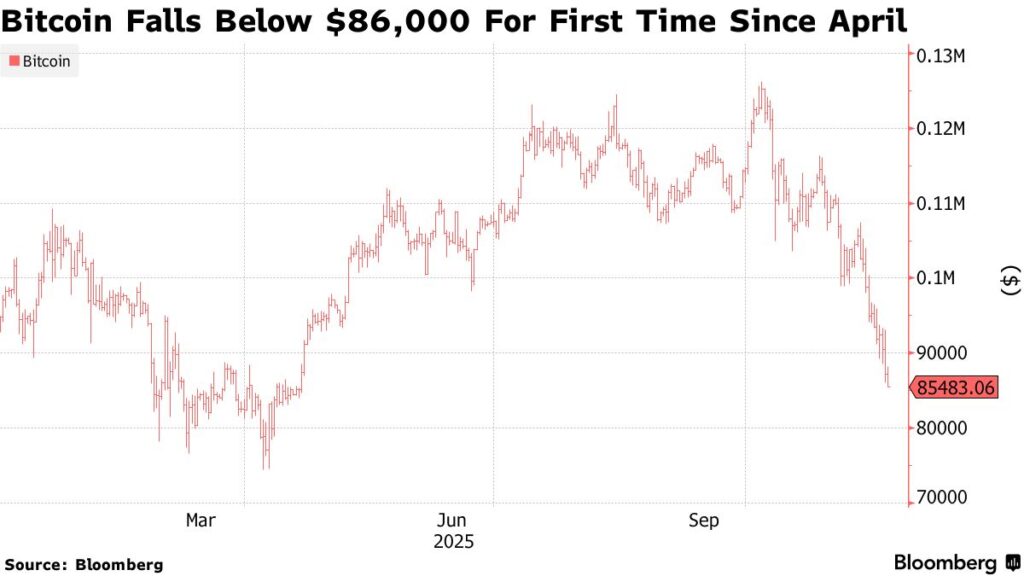
While traditional markets initially rallied on renewed enthusiasm for artificial intelligence—boosted by strong Nvidia earnings—those gains quickly disappeared. Concerns about overstretched AI valuations and uncertainty surrounding the Federal Reserve’s potential December rate cuts have fueled volatility across equities. Meanwhile, crypto is undergoing its own correction, marked by reduced leverage and declining retail participation, deepening the disconnect between digital assets and other markets since early October.
Options traders are watching the $85,000 level closely. Demand for protection at that price is the strongest on Deribit, followed by interest around $82,000, indicating expectations for further downside.
Bloomberg Strategists Weigh In
“Crypto’s breakdown has effectively removed one of the market’s major speculative vehicles. At this point, the sector isn’t the canary in the coal mine — it’s the coal mine itself, collapsing under the pressure of excessive leverage,”
said Brendan Fagan, Macro Strategist at Markets Live.
Bitcoin’s continued weakness can be traced back to October’s dramatic liquidation wave, when more than $19 billion in leveraged positions were cleared out in a single day. That event shattered market momentum and drained liquidity across major trading platforms. Since order books never fully recovered, even moderate selling now results in outsized price moves — a structural fragility that still shapes every downturn.
Adding to the uncertainty, macroeconomic concerns are weighing on investor sentiment.
“Markets are navigating a data gap that leaves the Federal Reserve’s next policy steps unclear,” said Jake Ostrovskis, head of over-the-counter trading at Wintermute. “That uncertainty is pushing investors away from high-risk assets, which is especially visible in crypto.”